Ambient scribes are one of the most widely adopted uses of AI in healthcare, and the evidence is getting better. A randomized trial in NEJM AI of 238 outpatient physicians found that one of two scribes significantly reduced time in notes, by 9.5% against usual care, while physicians reported clinically significant inaccuracies "occasionally." A blinded study in Frontiers in Artificial Intelligence reviewed notes from 97 encounters and found hallucinations in 31% of ambient notes, against 20% of the gold notes.
Taken together, these results point to a simple conclusion: the tools help, and they also make mistakes that matter. If you are building one, your evaluation has to find those mistakes before a tired clinician signs them. Standard speech metrics will not do that.
Why Word Error Rate Is Not Enough
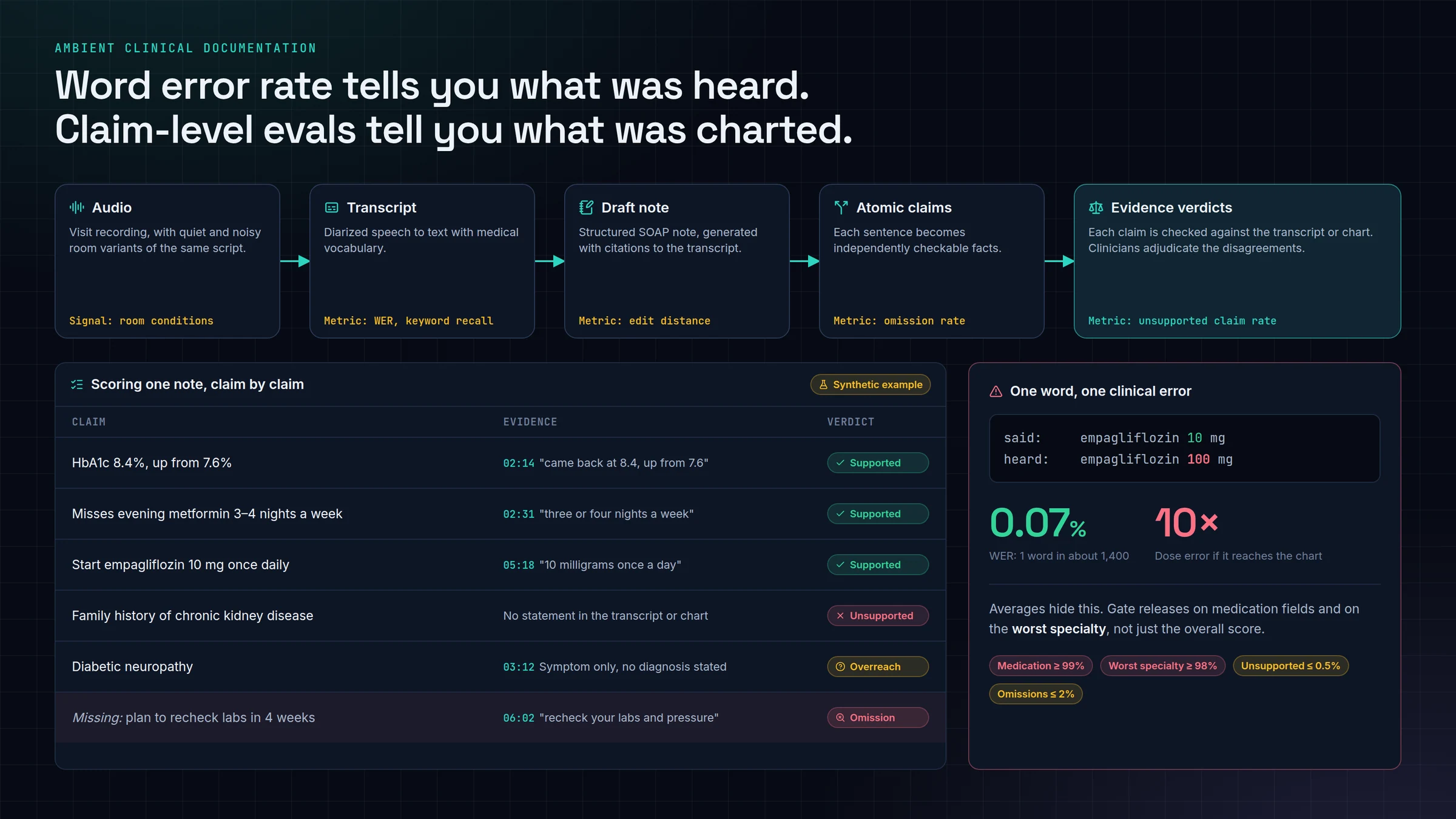
Word error rate treats all words as equal, and clinical language does not work that way.
said:    empagliflozin 10 mg
heard:   empagliflozin 100 mg
That single substitution barely moves WER, yet it is a tenfold dose error if it reaches the chart. A second problem is that WER stops at the transcript. It cannot catch a note that adds a family history nobody mentioned, or one that drops the follow-up plan, even when the transcript is flawless.
So you need metrics at each stage of the pipeline.
| Stage | Metric | What it catches |
|---|---|---|
| Transcript | WER, medical keyword recall | Misheard words, weak drug name recognition |
| Note, claim level | Unsupported claim rate | Statements with no evidence |
| Note, claim level | Critical omission rate | Key facts left out |
| Medications | Field-level accuracy | Wrong drug, dose, route, frequency, or basis |
| Review | Clinician edit distance | Drift, and how much work the draft creates |
Build a Gold Set You Can Share
You need encounters with reference notes that a clinician has reviewed. Using real visits makes this slow and legally heavy, so start with synthetic ones.
Script realistic encounters
Generate patient backgrounds with Synthea, then have clinicians write or review visit scripts and reference notes for each specialty you support.
Record under real conditions
Record each script in a quiet room and in a noisy one. Include accents, interruptions, and people talking over each other.
Add the hard cases on purpose
Include the patterns that cause real errors, listed below. Most of your useful failures will come from this group.
The hard cases deserve specific attention:
- Negation: "no chest pain" must not become chest pain.
- Attribution: a condition the patient's mother has must not land in the patient's own history.
- Self-correction: "start 10, no, make it 20 milligrams" must keep only the final dose.
- Soundalike drugs: hydroxyzine and hydralazine are a classic pair.
- Weight-based dosing: "45 mg per kg per day" must not lose its basis.
- Things not said: normal exam findings the clinician never mentioned must not appear.
Synthetic First, Not Synthetic Only
Synthetic data lets you build and share a gold set safely, but it will not contain everything real clinics produce. Before relying on these numbers, validate on a governed sample of real visits under your organization's privacy and review process.
Score Claims, Not Notes
A whole-note quality score hides the failure you care about. Instead, split each note into atomic claims and judge every one against the evidence.
from typing import Literal

from pydantic import BaseModel

Verdict = Literal["supported", "from_chart", "unsupported", "overreach"]


class Claim(BaseModel):
    text: str
    section: Literal["subjective", "objective", "assessment", "plan"]
    citations: list[str]  # transcript timestamps or FHIR references


class ClaimVerdict(BaseModel):
    claim: Claim
    verdict: Verdict
    evidence: str | None
    reasoning: str


def unsupported_rate(verdicts: list[ClaimVerdict]) -> float:
    if not verdicts:
        return 0.0
    failed = sum(v.verdict in ("unsupported", "overreach") for v in verdicts)
    return failed / len(verdicts)
The overreach verdict is worth keeping separate. If the patient says their toes tingle and the note says "diabetic neuropathy," the symptom is real but the diagnosis was never stated. That judgment belongs to the clinician, so the system should hold it for confirmation rather than delete it or file it.
Omissions run in the other direction. Start from a checklist of critical facts for each gold encounter, and check whether the note includes each one.
Run the Verifier Separately
Use the same claim check at runtime, but keep it independent from drafting. It should see only the claim and the evidence, not the drafting model's reasoning, because a model is inclined to agree with its own earlier output.
Calibrate this verifier like any other judge. Have clinicians adjudicate a sample, measure agreement, and look closely at the disagreements. An LLM judge is a useful way to scale a clinician's standard. It does not replace that standard.
Gate on the Worst Case
Averages are where safety problems hide. Imagine a release whose overall medication accuracy passes at 99.0% while pediatric accuracy is 96.8% because weight-based doses are losing their basis. An average-only gate ships it. Check each specialty separately.
from dataclasses import dataclass


@dataclass(frozen=True)
class Scores:
    unsupported: float
    omissions: float
    medication: float


LIMITS = Scores(unsupported=0.005, omissions=0.02, medication=0.99)
WORST_SPECIALTY_MEDICATION = 0.98


def release_blockers(overall: Scores, by_specialty: dict[str, Scores]) -> list[str]:
    blockers = []
    if overall.unsupported > LIMITS.unsupported:
        blockers.append(f"Unsupported claims {overall.unsupported:.1%}")
    if overall.omissions > LIMITS.omissions:
        blockers.append(f"Critical omissions {overall.omissions:.1%}")
    if overall.medication < LIMITS.medication:
        blockers.append(f"Medication accuracy {overall.medication:.1%}")

    for specialty, scores in by_specialty.items():
        if scores.medication < WORST_SPECIALTY_MEDICATION:
            blockers.append(f"{specialty} medication accuracy {scores.medication:.1%}")
    return blockers
These limits are starting points rather than clinical standards. Set your own with clinical leadership, and write down why you chose them. Small subgroups also have wide error bars, so a specialty with 40 encounters tells you where to look more than it proves a rate.
What to Watch After Launch
A gold set cannot show you everything. In production, monitor signals you can measure without storing more PHI than you need:
- Edit distance, as a drift signal rather than a quality score. A sudden drop may mean clinicians trust the drafts more, or that they have stopped reading them.
- Time to sign. Very fast signatures on long notes can indicate automation bias.
- Removed and held claims. A rising verifier rate often appears before users complain.
- Reported errors. Make it easy to flag a problem from inside the note, and turn every report into a new gold case.
Transcript accuracy is necessary, but it is not the goal. Score each claim against its evidence, measure medications field by field, build the hard cases on purpose, and gate on your worst specialty. A release that passes on average can still hurt a specific group of patients.
References
- Lukac PJ, Turner W, Vangala S, et al. Ambient AI Scribes in Clinical Practice: A Randomized Trial. NEJM AI, 2025.
- Palm E, Manikantan A, Mahal H, Belwadi SS, Pepin ME. Assessing the quality of AI-generated clinical notes. Frontiers in Artificial Intelligence, 2025.
- Synthea synthetic patient generator